
If you’ve ever wondered how Freight Broker commission splits actually work, you’re in the right place.
In this article, we’ll break down how commissions are calculated, what percentages Brokers and Agents typically earn, and why different brokerages use different split structures.
You’ll get a clear look at the most common models and what really drives your earnings, from experience and overhead to carrier relationships and who owns the book of business.
Whether you’re just starting out as a Freight Agent or you’re an established Freight Broker aiming to boost your profit margin, this guide will help you make sense of commission agreements and choose the brokerage partnership that sets you up for long-term success.
Let’s start with a question.
What Is a Freight Broker Commission Split?
Commission splits are the way a brokerage divides the profit (also called gross margin or net revenue) from a load between the brokerage and the Freight Agent who booked it.
It looks like this.
When booking a load, a Freight Agent negotiates a rate with the Shipper and a rate with the Carrier. The difference between those two rates is the profit.
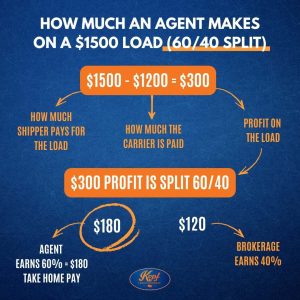
For example: If a Shipper pays $1,500 for the load and the Carrier is paid $1,200 of that payment, the profit on that load is $300.
$1,500 – $1,200 = $300 profit
Then that profit is split between the Freight Brokerage and the Freight Agent. The commission split decides how that profit is shared. If the split is 60/40, for instance, the Freight Agent keeps 60% of the profit and the Brokerage keeps 40%, which would look like this:
60% of $300 = $180 (this is what the Agent earns on the load)
40% of $300 = $120 (this is what the brokerage earns on the load)
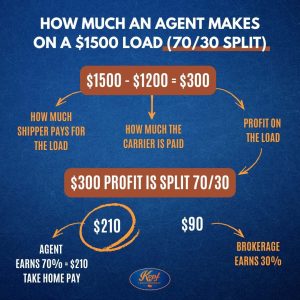
If the commission split was 70/30, the Agent would earn $210 (instead of $180) and the brokerage would earn $90 (instead of $120).
So, a commission split determines how much money an Agent actually earns per load and can influence which brokerage they choose to partner with.
It is important to note that some brokerages hire Agents as W2 employees. In this case, Agents may be salaried and earn bonuses. So when looking for a brokerage to partner with, it is important to clarify if you are a W2 employee or a 1099 contractor AND clarify pay structures.
How Freight Broker Commissions Work
In any business, revenue is sales, this is the “top line” of the financial picture. When you subtract expenses you are left with profit.
Revenue – Expenses = Profit
In the world of freight, revenue is generated from loads booked. This rate is negotiated between a Shipper and a Freight Agent and agreed upon before the load is moved from point A to point B. The expenses are typically the Carrier rate, or how much you’ll pay the trucking company or Truck Driver to transport the load. What is left after that is profit.
As you know from reading the previous section, profit is divided between the Freight Agent and the brokerage. This is known as the commission split. Freight Agents are typically 1099 independent contractors and are paid based on commission. The percentage of the commission split Freight Brokers keep covers operational costs like insurance, technology, business-office support, and potential bad debt.
An Agent’s earnings are based on a commission split of the profit.
Common Freight Broker Commission Structures
Since freight brokerages and Freight Agents earn commission from the profit of a load, the brokerage and Freight Agent share that margin using a negotiated split.
Here are the most common commission structures:
- 50/50 split
- 60/40 split
- 70/30 split (common for experienced agents with their own book of business)
- 80/20 split (less common)
- Flat-fee structures (less common)
- Salary + small commission variations
In each of these commission splits, the Freight Agent earns the larger percentage and the brokerage earns the smaller.
Bottom line: splits vary depending on the brokerage.
If you are an Agent without a book of business, target these industries, and look into these training classes to boost your success.
What Determines the Commission You Receive
There are a few considerations to keep in mind when comparing commission splits.
The first factor is the brokerage. Brokerages pay for overhead, Transportation Management Software, liability and insurance costs, surety bonds, carrier onboarding, claims handling, office support, and so on.
The second factor is the Agent. Some brokerages pay a higher rate for Agents who have more experience, a large book of business, and a strong performance history. Your sales performance and load volume can influence your commission split.
The third factor is industry norms. It is common for brokerages to offer 50/50, 60/40 and 70/30 splits. These are the percentages you will see most often.
Brokerages consider their expense to operate the business, the Agent they are bringing on, and industry norms to calculate their commission percentage.
Strategies to Maximize Your Commission Earnings
To increase your earnings, focus on strategies that boost both volume (the amount of loads you book) and profitability (how much you earn per load).
This includes reducing Carrier costs through stronger negotiation, increasing your overall load count, and building long-term relationships with Shippers. If you have satisfied customers, they are more likely to commit to you and become a consistent revenue stream.
You can also specialize in lucrative niches such as reefer, LTL (less than truckload), hazmat, and liquid bulk. These niches require specialized expertise and can significantly increase your revenue.
How to Choose the Right Freight Broker Commission Structure
Every brokerage sets its own commission split; therefore, it’s crucial for both new and experienced Freight Agents to look beyond the percentage and pay attention to what is included.
Make sure you’re evaluating things like:
- Transparency: How are commissions and fees calculated?
- Support: How much help will you get? How much freedom will you have?
- Access to reliable Carriers: Does the brokerage have their own trucks, a network of dependable Carriers, or provide technology to vet Carriers?
- Tools, technology, and business-office resources: What is provided to make your job easier?
- Financial stability: Is the brokerage financially sound? Do they have a strong track record of paying on time?
Choosing a brokerage based solely on commission split may not be best. Choose wisely by looking at the big picture…a brokerage that is trusted, financially sound, and provides you with the tools you need to succeed. (Pssst….take a look at our Agent Program!)
Picking the Best Commission Split for Your Goals
Now that we’ve taken a look at what commission splits are, how they work, common commission structures, factors affecting your commission split, and strategies to maximize your earnings, it’s time to choose the best split for you.
To recap, the most common models are 50/50, 60/40, and 70/30. However, if your goal is to create sustainable success, it’s also important to consider working with a brokerage that is reliable and will help you succeed.
That’s where Kopf comes in. Kopf has been a pioneer in the trucking logistics sector for over 45 years, offers a competitive commission split, is financially sound, and provides our Agents with award-winning TMS as well as a suite of tools to help you succeed.
At Kopf, we offer the best of both worlds: high commission and trusted support!
Looking to boost your book of business? Read this next.
Questions People Also Ask
How do freight broker commission splits work?
Freight brokerages and Freight Agents earn commission from the profit margin on a load. The brokerage and Freight Agent share margins using a negotiated split. This is often 50/50, 60/40, or 70/30 depending on the brokerage.
What is the average commission for a freight brokerage?
Most Freight Brokerages earn 30–40% of the load margin depending on their role. Independent Freight Agents often earn 60–70%.
What is a good commission split for a Freight Agent?
A competitive split is typically 60/40 or 70/30 for Agents bringing their own customers. Newer Agents may start with a lower split if the brokerage provides leads, tools, or heavy operational support. Kopf offers a competitive 70/30 commission split to Independent Freight Agents with experience, a strong performance history and a solid book of business.
How do Freight Agents get paid?
Freight Agents are almost always paid per load. Some brokerages offer Freight Agents weekly or biweekly payout cycles depending on their internal accounting systems. At Kopf, we offer weekly payouts to our Independent Freight Agents.
Why do commission splits vary between brokerages?
Splits differ based on overhead, support levels, customer ownership, business-office services, technology costs, and whether the brokerage provides leads or requires the Agent to build their own book of business.
I really would like to learn this industry.
Hi David! We recommend these top Freight Broker training classes to kickstart your career: https://kopflogisticsgroup.com/2024/10/freight-broker-training-classes/